Author: Prathamesh

  • Ctrl Z: When We Didn’t Record Everything

    Ctrl Z: When We Didn’t Record Everything

    Ctrl Z Series

    What Happens to a Moment When We Stop to Capture It?

    A simple evening with old friends became a small reminder of how naturally lived moments
    and carefully recorded moments do not always move in the same way.

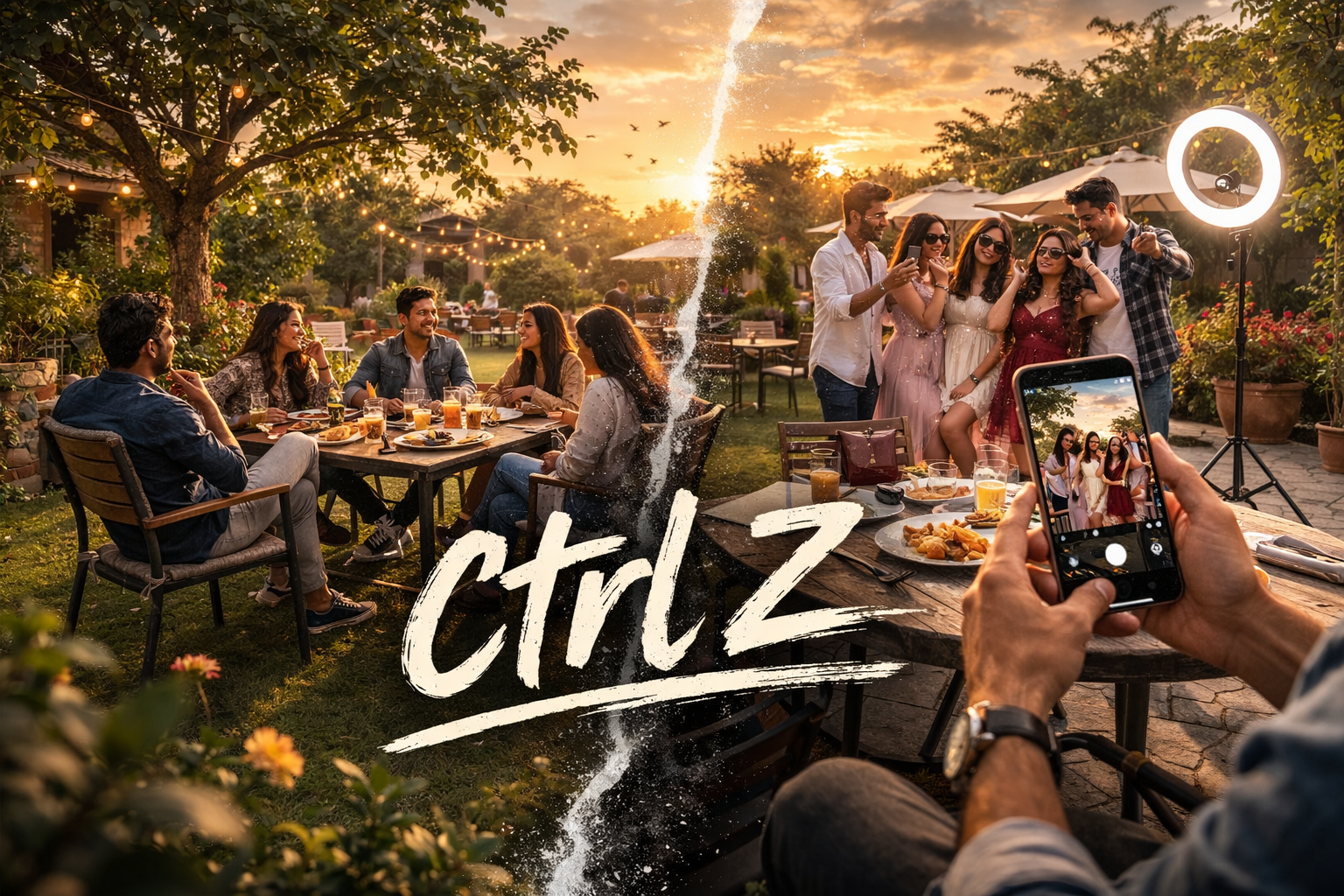
    Last weekend, I met a couple of old friends after a long time. There was no detailed planning behind it.
    We just picked a place, fixed a time, and showed up. The kind of plan that doesn’t need coordination, just availability.

    We ordered food, settled in, and the conversation started flowing almost immediately. It moved from one topic
    to another without effort—old stories, current work, random observations. Nobody was checking their phones.
    Nobody was in a hurry to leave.

    At some point, someone suggested taking a picture. We got up, stood together, and clicked one. Then someone
    asked for another because the angle could be better. Then one more because someone blinked. A few small adjustments
    followed, and we ended up taking several versions before everyone felt okay with it.

    We went back to our seats and picked up the conversation again. Everything continued, but the rhythm had changed
    slightly. The conversation restarted instead of continuing from where it left off. It wasn’t a major shift,
    just something you notice if you pay attention.

    The photo turned out well. The moment had already moved on.


    When Photos Were Occasional

    For a long time, photos were tied to specific occasions. Trips, celebrations, and events naturally called for
    a few pictures. Regular days passed without much documentation, and that felt complete.

    You could meet someone, spend hours talking, and walk away without feeling the need to capture it.
    The memory stayed with you in whatever form it took—clear in some parts, slightly faded in others.

    That was enough.

    Photos added value when they were taken, but they didn’t sit inside every moment.

    How Sharing Became Part of the Process

    As phones improved and social platforms became part of daily life, photos started carrying a different role.
    They moved from being stored to being shared, and that shifted how they were approached. A picture began to
    represent the moment beyond the people who were present. It became something that would be seen again later,
    by others as well. Naturally, a little more attention went into how it looked.

    That attention changed the timing. Capturing started happening during the moment instead of after it.
    A quick pause became part of the flow.

    Memory and Record

    The act of taking a photo is simple, but it brings a brief shift in focus. Attention moves toward the screen,
    toward getting the frame right, toward checking how it turned out. During those few minutes, the moment continues
    in the background, but the engagement changes. Conversations pause and then restart. The flow adjusts.

    Everything still happens, but in slightly separate parts instead of one continuous stretch.

    A memory holds what stood out—the tone of a conversation, a particular detail,
    a feeling attached to the experience.

    A recorded moment stays exact. It shows the scene as it appeared, with clarity and detail.

    Both have value. They simply hold different versions of the same experience.

    Ctrl Z Moment

    When you look at it closely, nothing about that evening felt unusual while it was happening. The conversation
    flowed the way it usually does when you meet people you’re comfortable with. There was no effort in keeping it
    going, no interruptions that stood out, and no reason to think about anything beyond what was happening at that table.

    The moment we paused for the picture didn’t feel important either. It was just something that fit naturally
    into the flow. Everyone stood up, adjusted themselves slightly, and spent a few minutes getting it right.
    At that point, it felt like a normal part of meeting after a long time, something almost expected.

    What becomes noticeable is not the act itself, but the small shift around it. The conversation didn’t continue
    from the exact point where it stopped. It had to restart, even if only slightly. The energy didn’t drop,
    but it changed form for a brief moment before settling again.

    That’s the part that usually goes unnoticed. The action feels normal, but the change it introduces is subtle
    enough to pass without attention. Over time, these small pauses become part of how moments are structured,
    even when they were never intended to be.

    Later, when I looked at the pictures, they were exactly what you would expect—clear, well-framed, and presentable.
    Anyone looking at them would assume it was a perfectly captured moment.

    But the experience behind them was different.

    What stayed with me wasn’t the image, but the process that led to it. The small push to make it happen,
    the time it took, and the way the moment had to pause and adjust around it.

    The rest of the evening didn’t need any of that. It moved naturally, without effort or planning.

    That contrast is easy to ignore in the moment. It becomes clearer only when you step back and think about it.

    My Perspective

    I see this happening everywhere now, not just in small gatherings like this.

    Walk through any public place—a street, a park, a cafe—and you’ll find people setting up cameras,
    asking others to move aside, repeating actions until it looks right. Entire moments are built around
    recording instead of experiencing. It’s no longer about remembering something later. It’s about presenting it immediately.

    And that’s where it starts feeling unnecessary.

    When a group is together, not everyone is there for the same reason. Some people want to talk,
    some want to relax, some just want to spend time without thinking about anything else.
    Turning that into a staged activity, especially when everyone isn’t equally interested, feels forced.

    A single picture at the end of a good evening makes sense. It captures something that has already happened.
    But stretching that into a series of poses, retakes, and adjustments changes the nature of the moment itself.

    There’s also a pattern behind this behavior.

    Research from the American Psychological Association (APA) has pointed out that frequent social media sharing
    is often linked to validation-seeking behavior and self-presentation pressure, where the focus shifts toward
    how an experience appears rather than how it feels. Another study published in the Journal of Consumer Research
    highlights that when people focus on capturing an experience extensively, it can reduce their enjoyment and
    engagement in that moment.

    These are not extreme cases. They’re common patterns. That’s why it stands out.

    Because the impact isn’t always loud or disruptive. It shows up quietly in moments that feel slightly altered,
    slightly staged, slightly less natural than they could have been.

    For me, the point of meeting people is simple. It’s about the conversation, the comfort, and the time spent
    without needing to document it constantly.

    Everything else should come after that.

    References

    1. American Psychological Association — research on social media behavior, self-presentation, and validation patterns.
    2. Journal of Consumer Research — findings on how extensive capturing can affect present-moment enjoyment and engagement.
  • Ctrl Z: When Work Stayed at Work (And How It Slowly Entered Everything Else)

    Ctrl Z: When Work Stayed at Work (And How It Slowly Entered Everything Else)

    March 2020: The Week Everything Changed

    March 2020 didn’t feel historic while it was happening. It felt abrupt.

    One week, work looked normal commutes, office desks, in-person meetings, casual conversations near coffee machines. The next week, everything stopped. Offices shut down quickly, and within days, organizations asked employees to work from home “until things stabilized.”

    There was no perfect setup. People worked from dining tables, bedroom corners, or wherever they could find space. Internet upgrades became urgent, VPNs became essential, and video calls became the new meeting rooms almost overnight.

    At that point, no one was planning for a long-term shift. It felt temporary, almost like an extended interruption. There was uncertainty, but also a sense of adjustment that people were willing to make. In some ways, it even felt manageable—no commute, more time at home, slightly flexible schedules.

    It didn’t look like the beginning of a structural shift in how work would exist.

    April–June 2020: Learning How to Work Without an Office

    Within a few weeks, organizations and teams began adapting faster than expected. Work didn’t pause but it reorganized itself.

    Daily stand-ups moved to video calls. Weekly reviews continued, just on different platforms. Conversations that earlier required a quick desk visit now happened through chat windows. Emails increased, but instant messaging increased even more.

    Despite all of this, there was still an attempt to preserve structure. Most people tried to follow fixed working hours. Logging in at a certain time and logging out at a reasonable hour still mattered.

    There was also a level of understanding across teams. Managers knew this was an unusual situation. Expectations were adjusted. Deadlines were revisited. The overall tone was more flexible, more human.

    Work continued, but it still had a beginning and an end.

    Late 2020: When Remote Work Stopped Being Temporary

    By the end of 2020, it became clear that this wasn’t a short-term arrangement.

    Remote work was functioning well enough for organizations to rely on it. Projects were being delivered, clients were being managed, and collaboration was happening without physical presence.

    Companies started formalizing this model. They invested in better tools, created structured workflows, and defined remote work policies. What began as an adjustment turned into a system.

    This is also when communication patterns started changing more noticeably.

    Earlier, conversations were constrained by time and availability. Now, messages could be sent anytime. And more importantly, they were. A question didn’t need to wait until the next morning. A follow-up didn’t need to be scheduled.

    The system became faster, but with that speed came a subtle shift in expectations.

    2021: When the Workday Started Stretching

    By 2021, remote work had stabilized operationally. Teams knew how to function in this setup, and output remained consistent.

    However, the workday itself started losing its boundaries.

    A message would come in just after working hours. A quick call would get scheduled in the evening. A follow-up email would appear later at night. Individually, each of these felt reasonable. None of them seemed excessive in isolation.

    But collectively, they extended the workday.

    There was no formal change in policy. No one announced longer hours. Yet, in practice, work began occupying more time than before.

    People adapted without consciously deciding to. Checking emails after dinner became normal. Responding to messages late in the evening didn’t feel unusual. Preparing for the next day started blending into the current one.

    The shift wasn’t forced. It was absorbed.

    2022: Hybrid Work and the Return That Didn’t Restore Boundaries

    When offices began reopening, hybrid work was introduced as a balanced approach. A few days in the office, a few days at home. It looked like a solution that combined flexibility with structure.

    In reality, it didn’t restore boundaries it redistributed effort. Office days became dense with meetings, discussions, and coordination. Work-from-home days became focused on execution, catching up on tasks that required uninterrupted time.

    The expectation didn’t reduce. It spread across both environments.

    Instead of separating work and personal time again, hybrid work often made accessibility permanent. You were available in the office, and you remained available outside it.

    The boundary that once existed didn’t return.

    2023: When Speed Became an Unspoken Standard

    As teams became more comfortable with digital work environments, speed started influencing perception.

    Quick responses became visible indicators of engagement. Being available across time zones became associated with reliability. Responsiveness, even outside working hours, began to shape how involvement was perceived.

    At the same time, the nature of work itself started changing.

    With constant communication channels open, interruptions increased. Context switching became frequent. Deep, focused work, work that required uninterrupted time became harder to sustain.

    Work didn’t necessarily become more complex. But it became more fragmented. And fragmentation changes how work feels, even if the volume remains the same.

    2024–2025: AI Enters and Changes the Pace Again

    Around this time, AI moved from being an emerging concept to a daily tool.

    It started with small use cases drafting emails, summarizing documents, generating ideas. Gradually, it expanded into more critical tasks;  content creation, analysis, coding assistance, decision support.

    The immediate impact was clear.

    Tasks that earlier required hours could now be completed in minutes. Output improved. Effort reduced. Efficiency increased.

    At first, this felt like relief. But over time, it introduced another shift this time in expectations. If something can be done faster, it is expected to be done faster. Timelines began shrinking. Turnarounds became tighter. What was earlier considered a reasonable deadline started getting compressed.

    AI didn’t create the always-on culture. That was already in motion. But it accelerated it.

    By reducing the effort required for execution, it increased the volume of what could be done within the same time frame. And when capacity increases, expectations tend to follow.

    2026: When Work Became Continuous

    Today, remote and hybrid work are standard. AI is embedded into workflows. Communication is instant, and execution is faster than ever. But one of the most noticeable changes is how work fits into time. It no longer has a clearly defined start and end. Instead, it flows throughout the day.

    You might check something before officially logging in. Respond to a message during a break. Complete a task later in the evening. Review something before the day ends.

    None of this feels unusual anymore.

    That’s the shift.

    What was once considered “extra” has become routine.

    It’s easy to attribute this transformation entirely to remote work or AI. But the shift is a combination of multiple factors working together. Work is now always accessible. Communication is instant. Execution is faster. And most importantly, behavior has adapted quickly to all of this. Remote work enabled access. AI accelerated execution. But it is the way people adjusted to both that turned them into expectations.

    The Trade-Off That Isn’t Obvious

    There are clear advantages to this new way of working.

    Flexibility has improved. Commute time has disappeared. Collaboration across geographies has become easier. Tools have made work more efficient.

    But something less visible has changed.

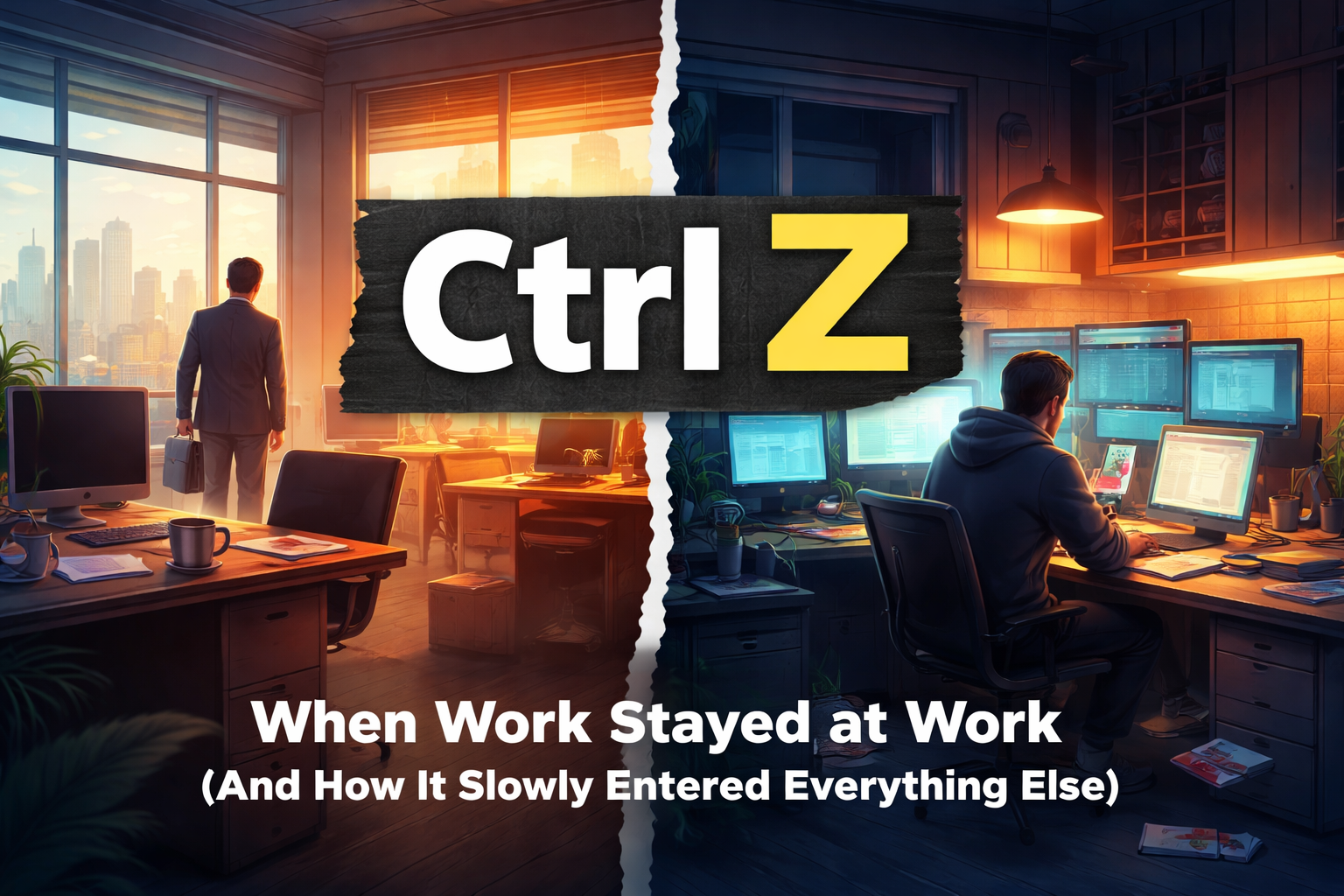
    Earlier, work had closure. The end of the day was defined by leaving the office. There was a natural pause. Now, closure depends on a decision.

    And that decision is harder to make when work continues to generate inputs messages, updates, notifications without stopping.

    Why This Matters Over Time

    This isn’t just about working longer hours. It’s about how work is experienced daily.

    When there is no clear boundary, recovery time reduces. Focus becomes harder to sustain. Work starts overlapping with everything else meals, conversations, downtime.

    AI makes work faster, but faster execution doesn’t automatically mean better outcomes. In many cases, it simply allows more work to fit into the same day.

    Over time, this affects consistency, decision-making, and overall quality of work.


    Ctrl Z Moment

    If you could go back to early 2020, knowing how things would evolve, what would you keep?

    The flexibility is valuable. The ability to work from anywhere has clear advantages. AI-driven efficiency has undeniable benefits.

    But maybe the system would be designed differently.

    Clearer boundaries. Defined offline time. A structure where availability doesn’t quietly turn into expectation.

    Because the biggest change wasn’t just where work happens. It was how much space it occupies.

    Work didn’t suddenly take over personal time.

    It entered gradually through convenience, speed, and tools that made everything easier.

    Remote work made access constant. AI made execution faster. Together, they reshaped how work fits into everyday life.

    The question is simple:

    Did we redesign work or did we just remove its boundaries?


    How did work from home change work-life balance after 2020?

    Work from home increased flexibility but blurred boundaries, often leading to longer working hours and reduced separation between personal and professional time.

    How has AI impacted workplace productivity?

    AI has significantly improved speed and efficiency but has also led to tighter deadlines and higher expectations for faster output.

    What is always-on work culture?

    It refers to a work environment where employees feel expected to stay connected and responsive beyond standard working hours.

    Why does remote work sometimes feel more exhausting?

    Because of constant communication, increased interruptions, and the absence of clear start and end times.

    How can professionals manage work in an AI-driven, remote environment?

    By setting clear boundaries, prioritizing deep work, and avoiding the pressure to be constantly available.