
There is a special kind of timing some people have in meetings.
They stay quiet when the idea is still floating in the room. They do not support it when it is raw. They do not help it when it is vulnerable. They do not add courage when it needs courage.
They simply wait. Then the moment the idea starts looking useful, the moment people begin to notice it, the moment the room gives it a little attention, they suddenly appear with a familiar line.
“I was thinking the same thing.” Of course they were.
Apparently, the thought was sitting inside them all along, fully formed, quietly waiting for someone else to say it first.
The Convenient Arrival of Shared Genius
Sometimes this sentence is harmless. We have all had moments where someone else says what we were trying to articulate. That is normal. In a healthy room, agreement can build momentum. A good idea often becomes stronger when others genuinely recognize it.
But there is another version of this sentence.
This version does not arrive as support. It arrives as a small ownership claim. It tries to make the idea feel less like yours and more like something that was already obvious to everyone. It does not say, “That is a strong point.” It says, “Yes, yes, I had that too.”
And there is a difference.
One response gives credit. The other quietly dilutes it.
The idea may have come from your observation, your risk, your clarity, or your willingness to say the thing first. But with one sentence, someone else tries to reduce the distance between your thinking and their silence. Suddenly, your point is no longer a moment of clarity. It becomes a shared atmosphere.
How convenient.
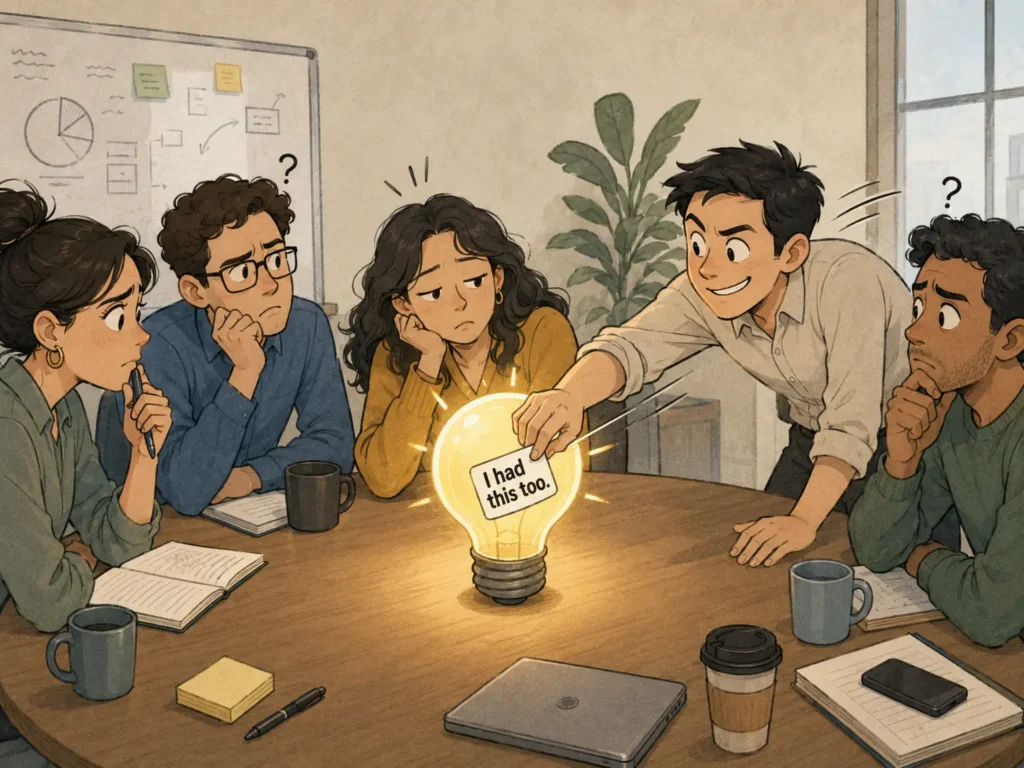
Some People Cannot Let a Good Idea Belong to Someone Else
This is where it gets interesting.
Some people do not just want to agree with a good idea. They want to be seen as someone who could have had it first. The idea is too good to simply appreciate. It threatens something small inside them. Maybe their image. Maybe their position in the room. Maybe the quiet belief that they are supposed to be the smartest person near the whiteboard.
So they do not attack the idea. That would be too obvious.
They absorb it.
“I was thinking the same thing” becomes a soft little takeover. It allows them to stand close enough to the idea to share its glow, without having done the uncomfortable part of saying it first. They did not risk the silence. They did not risk the blank faces. They did not risk the possibility of being wrong before the room decided it was right.
But once the idea looks safe, they arrive with a chair and sit beside it.
This is not collaboration. This is intellectual loitering.
Then Comes the Useless Addition
The performance usually does not end with “I was thinking the same thing.” That would still leave the original idea too intact.
So the second move begins.
They add something.
Not always something useful. Often, it is just enough to leave a fingerprint. A small tweak. A slightly different angle. A sentence that starts with “Maybe we can also…” and then goes nowhere important. The point is not to improve the idea. The point is to avoid looking like they only followed it.
Because simply saying, “That is good,” requires humility.
Adding an unnecessary suggestion gives the illusion of superiority.
Now the idea has been acknowledged, borrowed, and slightly scratched. The person has managed to attach themselves to it while also standing above it. They are not merely agreeing. They are “building on it.” They are “adding perspective.” They are “taking it one step further.”
Sometimes they are doing none of those things.
Sometimes they are just writing their initials on someone else’s clarity.
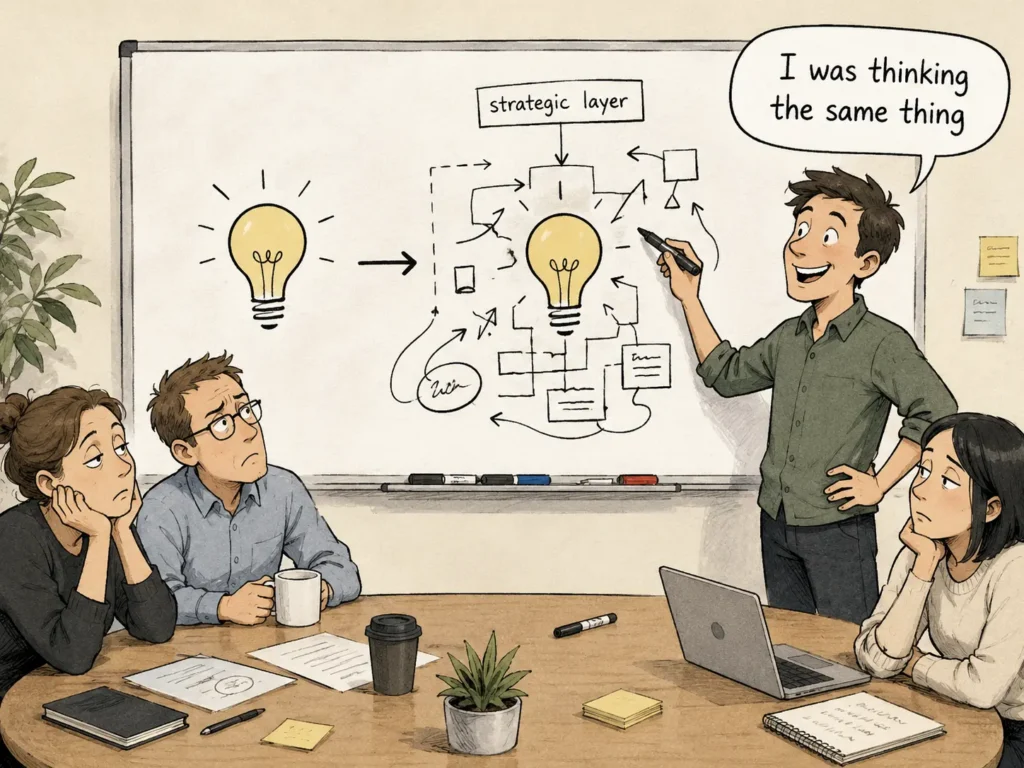
The Room Often Rewards the Wrong Person
Approval culture makes this worse because rooms do not always remember who brought the thought. They remember who made it sound safer, or bigger.
A simple idea may be ignored when it comes from the person who actually noticed it. But when someone else repeats it with more confidence, more volume, or more authority, the room suddenly treats it like a breakthrough. The idea did not become smarter. It just changed costume.
This is how people learn the wrong lesson. The quiet thinker learns that being first is risky and being credited is not guaranteed. The thunder stealer learns that waiting can be profitable. The room learns nothing, because the meeting notes will simply say, “Team discussed new direction.”
Very democratic. Very inaccurate.
And slowly, people stop offering ideas when they are still fragile. They wait until they have proof, backup, allies, and maybe a witness. Not because they are insecure, but because they have seen what happens when an idea enters the room alone.
Someone else may walk out holding it.
Agreement Should Not Be a Disguise for Theft
The sad part is that real agreement is useful. A good room needs people who can recognize a strong thought and help it travel further. There is nothing wrong with saying, “I was thinking along similar lines,” if you actually add context, build honestly, and acknowledge where the idea came from.
The problem begins when agreement becomes a polite disguise for taking credit.
There is a simple way to avoid that.
Say the person’s name.
“That’s a strong point. I think what she said is worth building on.”
“He has framed this well. I had a related thought.”
“This connects with something I was considering, but this version makes it much clearer.”
See? Nobody dies. The ceiling does not collapse. Your professional identity survives the horrifying act of giving someone else credit.
In fact, it may even improve.
Because people who can recognize good thinking without trying to own it usually look more secure than people who keep placing invisible flags on other people’s ideas.
Closing Thought
“I was thinking the same thing” is not always a problem. Sometimes it is genuine. Sometimes it is natural. Sometimes it is exactly how ideas become stronger.
But when it is used to shrink someone else’s moment, it becomes something else.
It becomes a small act of theft dressed as agreement.
And the people who do it know exactly what they are doing. They are not confused. They are not contributing. They are trying to stand close enough to the idea to collect light from it.
The next time someone says a good thing before you do, try something radical.
Let them have it. You can still build on it. You can still add to it. You can still make the work better.
But first, let the room know where the thought came from.
That is not weakness. That is basic intellectual hygiene.