
The problem was never the tool. The problem was always the thinking people were trying to avoid.
There is a strange comfort in blaming AI for everything. Bad writing? AI did it. Generic ideas? AI did it. Lazy thinking? AI did it. Ten people sending the same “personalized” email with different company names? Obviously, AI did it.
It is convenient. Almost too convenient. Because before AI arrived, the world was already full of lazy thinking. People were already writing vague emails, making empty presentations, copying formats, recycling opinions, and calling borrowed thoughts “strategy.” AI did not invent any of that. It simply removed the waiting time.
Now the laziness has become faster, cleaner, and occasionally better formatted. That is the real discomfort. AI did not suddenly make people lazy. It exposed the people who were already outsourcing their thinking — earlier to templates, now to tools.
The tool is not the thinker
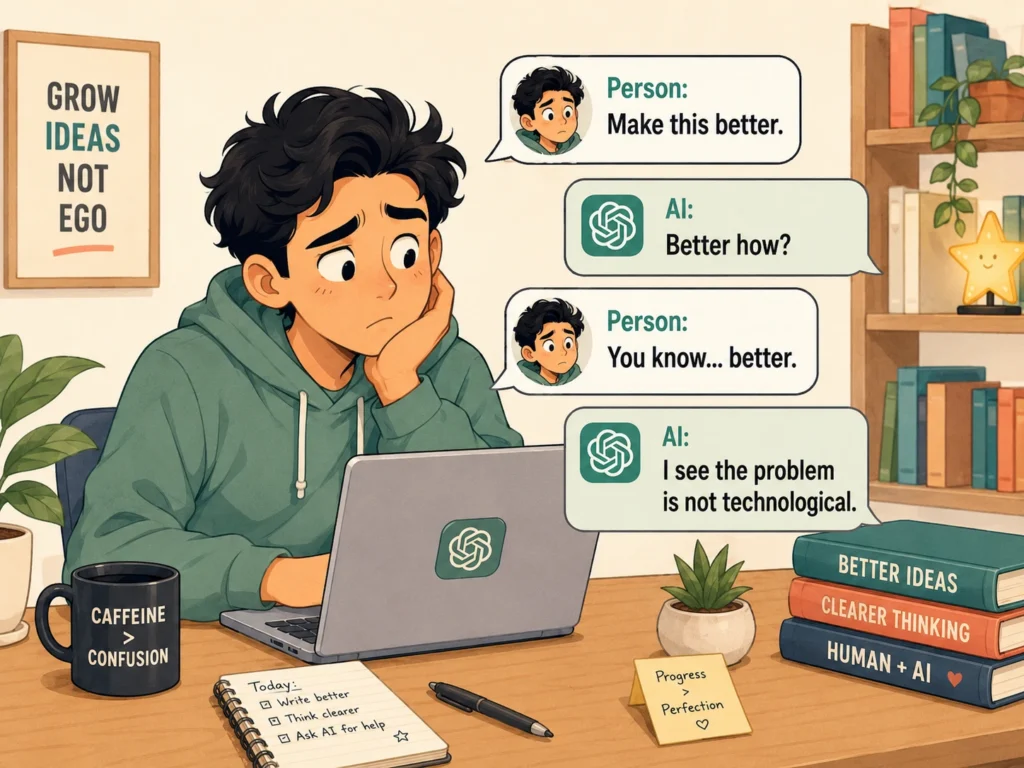
The biggest misunderstanding around AI is that people treat it like a thinking replacement. They open a tool, type something vague like “make this better,” and expect a miracle to walk out wearing a blazer.
But better than what? Better for whom? Better in what sense? Sharper? Warmer? Shorter? More persuasive? More human? More direct? More useful? Most people do not answer these questions because answering them requires thinking. And thinking, unfortunately, has not yet been automated without consequences.
So they give AI a half-dead prompt and then complain that the output has no soul. That is like giving someone flour, water, and emotional confusion, then getting angry because it did not become biryani.
AI has made average work easier to spot
Earlier, mediocre work had hiding places. It could hide behind time taken. It could hide behind long email threads. It could hide behind “I worked on this for two days.” It could hide behind complicated formatting, big words, and the sacred corporate phrase: “Please find attached.”
Now, AI can produce something decent-looking in seconds. Which means a long document no longer proves depth. A polished deck no longer proves thinking. A clean email no longer proves clarity. A 1,200-word article no longer proves that someone had something to say.
This has made many people uncomfortable because AI has separated output from thinking. Earlier, if someone produced a lot, we assumed they had worked hard. Now, we are forced to ask a more difficult question: did they think well?
The sudden rise of AI experts
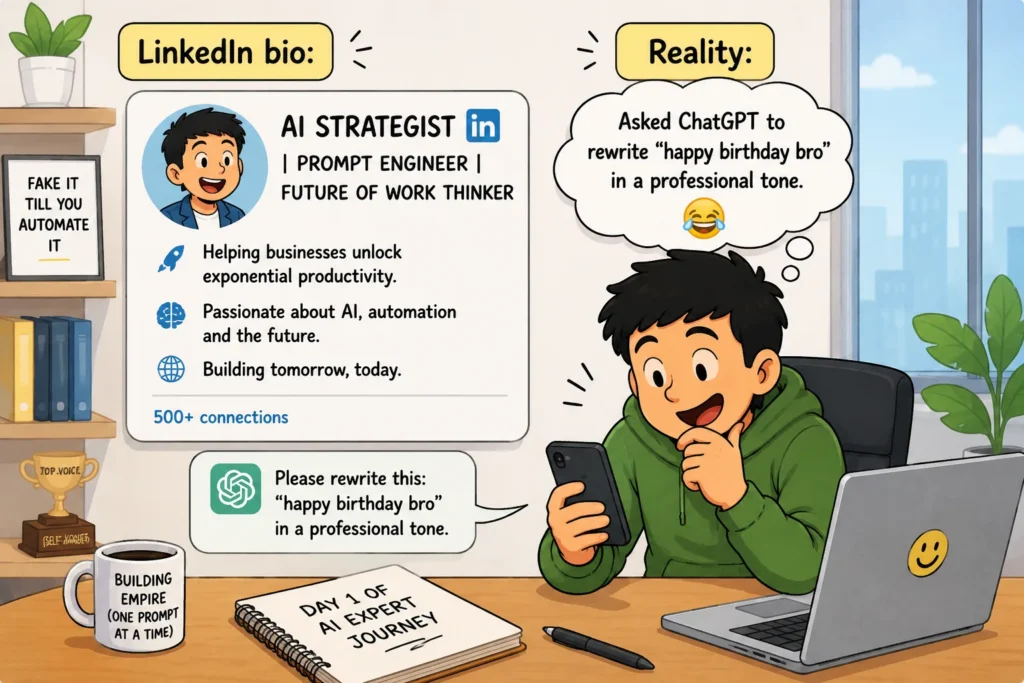
Every new technology creates a new species of expert. With AI, this happened at record speed. One week someone was asking ChatGPT to write birthday captions. The next week, they had become an “AI transformation advisor” helping businesses “unlock exponential productivity.”
You have to admire the confidence. It takes a special kind of courage to discover a tool, generate three posts about it, and immediately begin advising humanity.
The internet is now full of people who speak about AI with the confidence of a surgeon and the depth of a person who has only watched the trailer. They use words like “agentic,” “workflow,” “disruption,” and “AI-native” with such seriousness that you almost forget they are mostly describing a prompt they copied from someone else.
The problem is not that people are learning AI. Everyone should. The problem begins when learning becomes posturing. When curiosity becomes a personal branding opportunity. When someone mistakes tool familiarity for understanding.
AI rewards people who know what they want
The best use of AI starts before the prompt. It starts with taste, judgment, context, and intent. It starts with the ability to look at something and say, “This is not working, and here is why.”
AI is powerful in the hands of someone who already thinks clearly. It becomes a collaborator, a sparring partner, and sometimes a fast intern with infinite patience and occasional overconfidence. You can push it, challenge it, redirect it, correct it, and use it to move through possibilities faster than before.
But in the hands of someone who does not know what they want, AI becomes a vending machine for mediocrity.
AI does not remove thinking. It changes where thinking belongs.
Lazy use
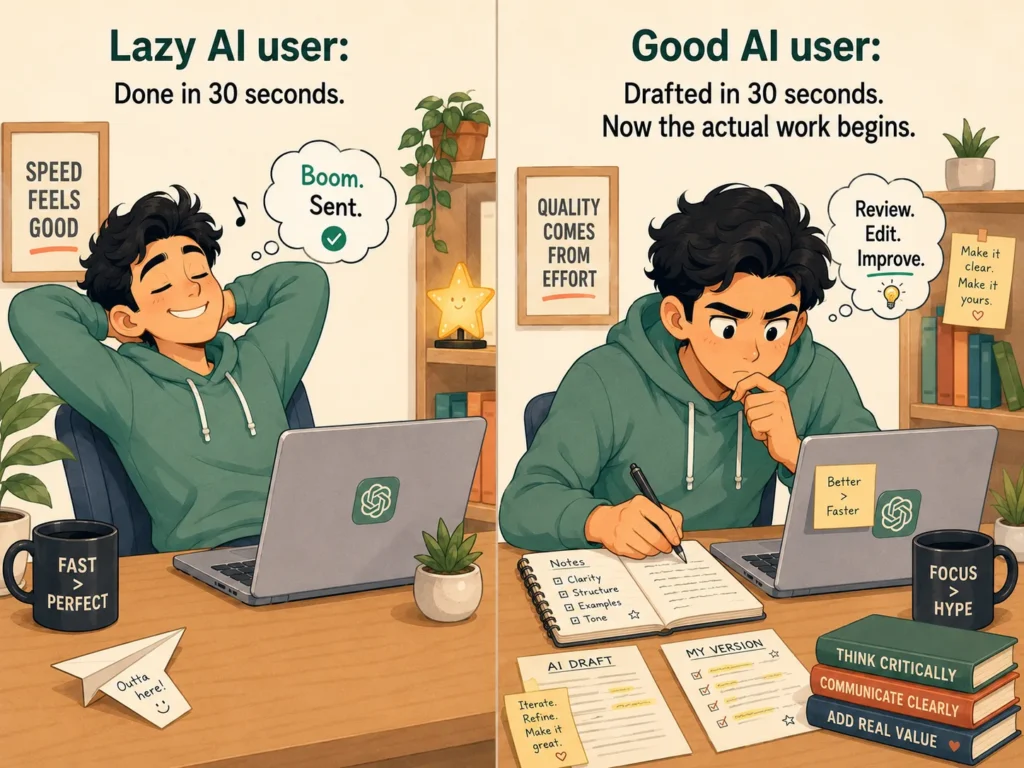
“Do this for me.” The goal is to avoid effort and accept the first decent-looking answer.
Average use
“Give me options.” The person chooses quickly, edits lightly, and calls it done.
Good use
“Think with me.” The person adds context, challenges output, edits sharply, and uses judgment.
“Just use AI” is not a strategy
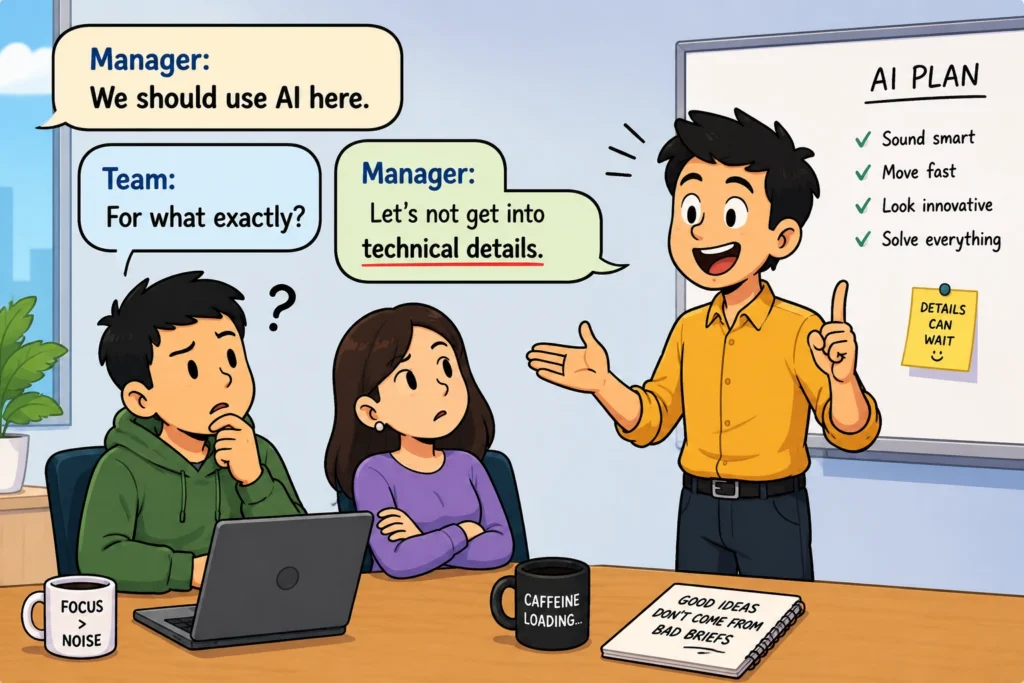
“Just use AI” has become the new “just Google it.” It sounds helpful. It often is not.
Because many people say “use AI” the way people say “be strategic.” It is not guidance. It is a noise people make when they want to appear current.
What exactly should AI do? Summarize? Analyze? Rewrite? Compare? Generate? Challenge? Automate? Personalize? Find patterns? Create a first draft? Test an assumption? Improve a process? Save time? Improve quality?
All of these are different things. But in many workplaces, “use AI” has become a magical instruction. A person gives unclear input, receives a generic output, and then forwards it as progress.
Generic people are producing generic AI content
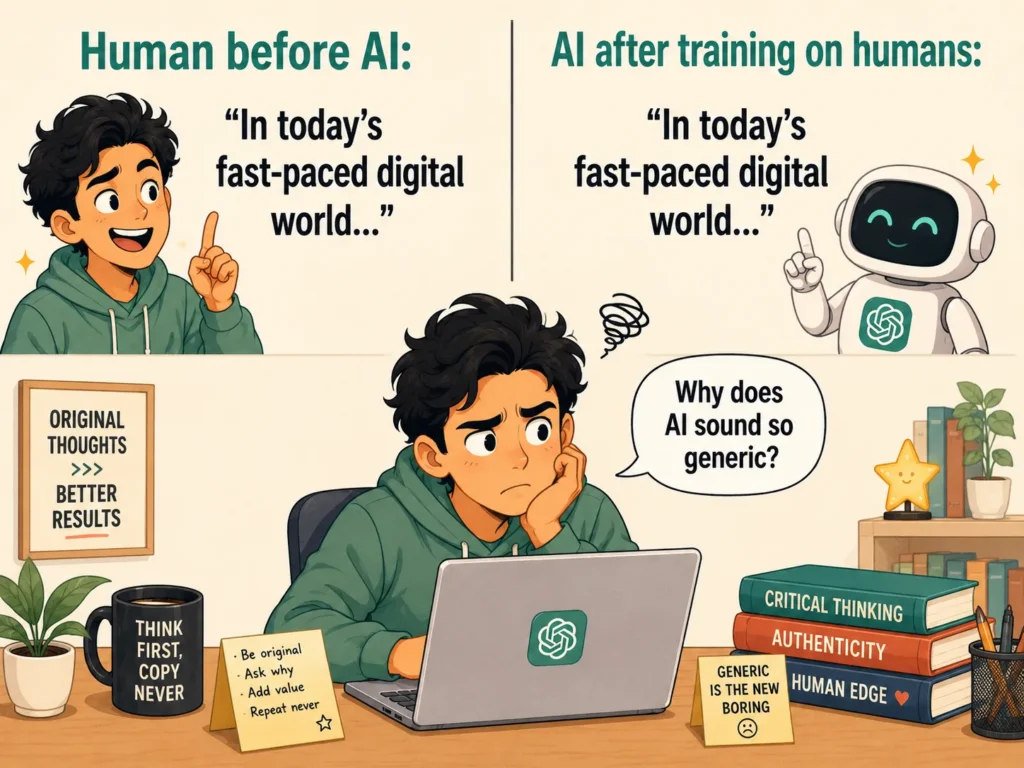
There is a popular complaint that AI content sounds the same. Yes, it often does. But here is the uncomfortable part: many humans sounded the same before AI entered the meeting.
The clichés were already there. “In today’s fast-paced world.” “Now more than ever.” “Unlock the power of.” “Seamless experience.” “Game-changing innovation.” “Future-proof your business.”
AI did not travel from another universe carrying these phrases. It found them lying around everywhere, already overused by humans in decks, blogs, brochures, emails, and keynote speeches.
The real issue is not that AI writes like a machine. The issue is that too many people have been writing like machines for years, and now the machine has caught up.
AI changes where the effort goes
The lazy version of AI says: “Do this for me.” The better version says: “Think with me.”
That difference matters. People who use AI well often spend more energy, not less. They ask sharper questions. They test more variations. They edit harder. They compare angles. They reject easy answers. They bring in context. They make choices.
AI can remove repetitive work, speed up research, organize chaos, and create first drafts that would otherwise take hours. That is useful. That is real. But it does not remove the responsibility of judgment. In fact, it increases it.
When output becomes easy, judgment becomes more important. When everyone can produce, the real difference is who can decide what is worth producing.
AI has also improved productivity theatre
We have always found ways to look busy. Earlier it was calendar blocks, long email chains, “circling back,” and walking fast while holding a laptop. Now it is screenshots of AI workflows, 47-tool stacks, and posts that begin with, “I automated my entire day.”
Wonderful. Did it improve anything, or did you just create a more sophisticated way to avoid doing the hard part?
There are people building automations for tasks that did not need to exist. People creating dashboards nobody asked for. People generating summaries of summaries of meetings that should have been cancelled. People using AI to write emails that another person will use AI to summarize before replying with “noted.”
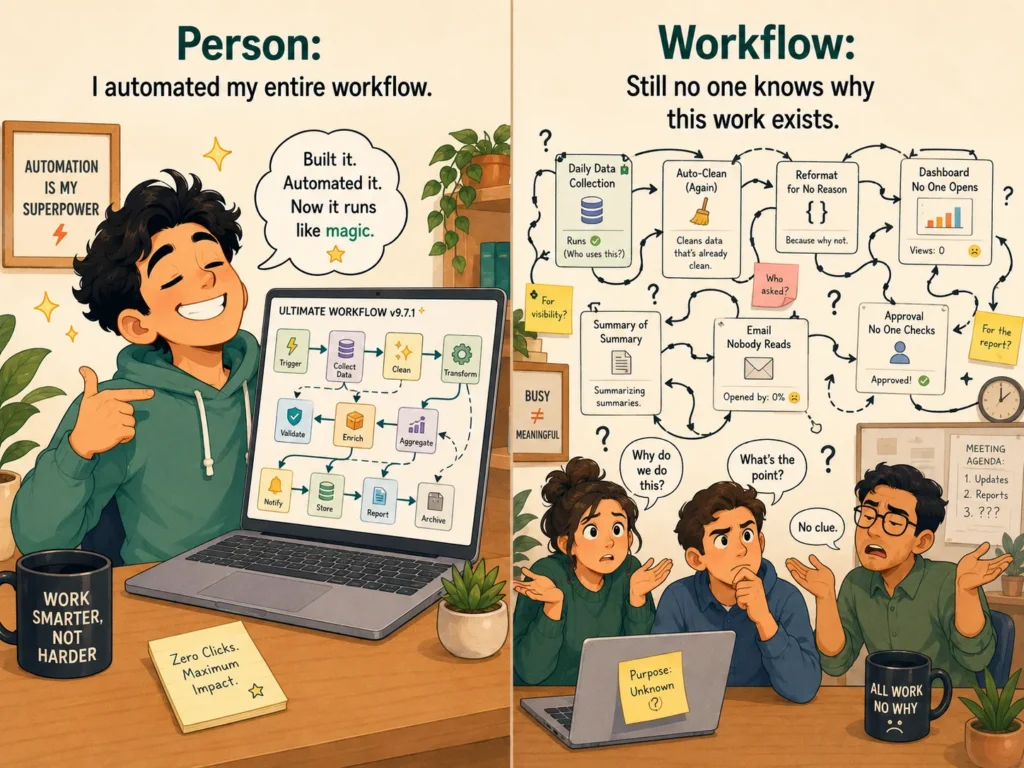
At some point, we have to ask whether we are saving time or simply creating faster loops of nonsense.
AI is a mirror, not a mask
The most interesting thing about AI is not that it can generate answers. It is that it reveals the quality of the person asking.
A vague person gets vague output. A lazy person gets polished laziness. A curious person gets pathways. A sharp person gets leverage. A thoughtful person gets a faster way to explore complexity. A fake person gets a better costume.
That is why AI feels exciting to some people and threatening to others. It exposes habits. It exposes taste. It exposes whether you know how to question an answer. It exposes whether you can tell the difference between something that sounds good and something that is good.
So, did AI make people lazy?
No. It gave lazy people better equipment.
It gave average work better packaging. It gave unclear thinking a faster route to publication. It gave fake experts a new costume. It gave performers another stage. It gave managers a new word to use when they do not want to define the problem.
But it also gave thoughtful people a powerful advantage. It gave builders a way to move faster. It gave writers a way to test ideas. It gave marketers a way to explore angles. It gave non-technical people a way to prototype. It gave curious people a way to learn by doing.
That is the part I find exciting.
AI is not here to save us from thinking. It is here to make unclear thinking harder to hide. So maybe the question is not whether AI made people lazy. Maybe the better question is: when AI reflects your thinking back at you, do you like what you see?