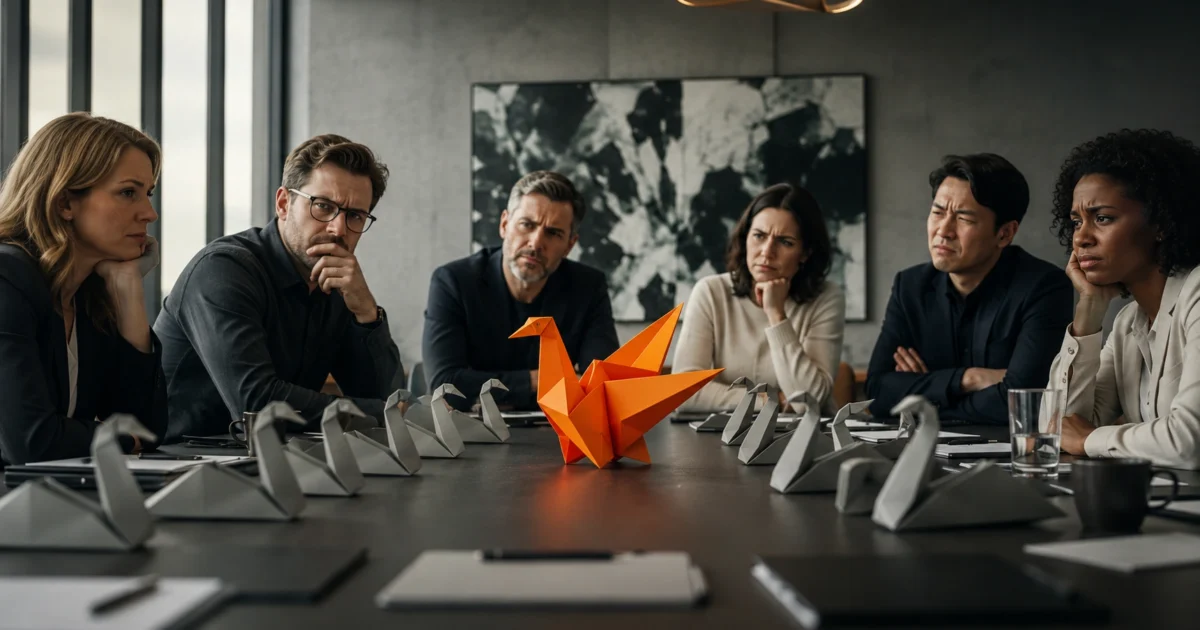
Everyone says they want original thinking.
Until someone actually brings it into the room.
Then suddenly the room becomes deeply interested in risk, alignment, brand fit, stakeholder comfort, best practices, previous benchmarks, leadership optics, audience expectations, and whether we should “take a step back.”
Originality is loved in theory. In practice, it is treated like a suspicious bag left unattended near the reception desk.
People praise originality because it sounds modern. Nobody wants to say, “We prefer safe, familiar, pre-approved thinking that looks fresh only because the font changed.” So we use better words. We say we want bold ideas. We want fresh thinking. We want disruptive concepts. We want to challenge the status quo.
But most of the time, what we really want is something that feels new without making anyone uncomfortable.
And that is where originality starts dying quietly.
The safest original idea always wins
The most accepted “original” idea is usually not original at all. It is familiar thinking wearing a slightly better jacket.
It has the comfort of something people already understand, with just enough cosmetic freshness to make everyone feel progressive. It does not question too much. It does not disturb anyone’s assumptions. It does not require someone senior to admit that the old way may not be working anymore.
You see this everywhere. A brand says it wants a bold campaign, but the final version looks exactly like the last five campaigns with a new color palette. A team says it wants fresh thinking, but every fresh idea is compared to “what competitors are doing.” A company says it wants innovation, but the first question in the room is, “Has anyone else tried this before?”
That is a funny question, because if everyone else has already tried it, then congratulations, we are not discussing originality anymore. We are discussing participation. 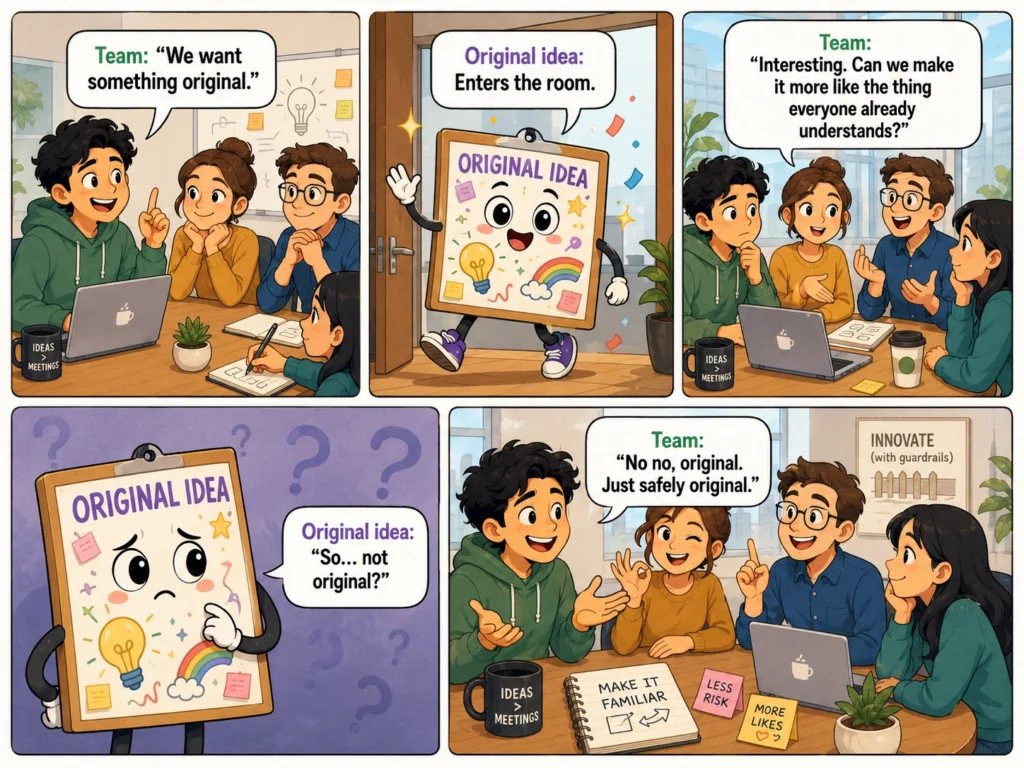
That is why so many ideas sound the same. Not because people are incapable of originality, but because originality has to pass through several layers of fear before it reaches the final version.
By the time it survives all the edits, approvals, suggestions, concerns, “just one small change” comments, and “can we make it more aligned?” requests, the idea is no longer original.
It is a hostage with a PowerPoint template.
People do not reject originality. They domesticate it.
The funny thing about original ideas is that they rarely get rejected immediately. That would be too honest.
Instead, they are softened.
Someone says, “This is interesting,” which is often the corporate version of putting an idea in quarantine. Someone else says, “Maybe we can simplify it,” even when what they mean is, “Can we remove the part that made it different?” Then someone adds, “Let’s make it more relatable,” which can sometimes mean, “Let’s make it look like the thing everyone else is already doing.”
And slowly, the idea starts losing its teeth.
The sharp line becomes a safer line. The uncomfortable point becomes a polite observation. The strange visual becomes a standard banner. The honest message becomes “driving meaningful impact in a rapidly evolving landscape.”
Congratulations. The idea is now approved.
Also dead.
This happens in writing too. A line that actually sounds human gets replaced because it feels “too direct.” A funny observation gets removed because someone worries that “not everyone may get it.” A simple message becomes a long, diplomatic paragraph because no one wants to sound too sure of anything.
So instead of saying, “This is broken,” we say, “There may be an opportunity to further optimize the current approach.”
This is how originality dies: not by rejection, but by professional moisturizing.
Why originality makes people nervous
Originality is uncomfortable because it creates responsibility.
A copied idea is easy to defend. You can point to examples. You can say competitors are doing it. You can say it follows best practices. You can say the market is already familiar with this format. Nobody gets blamed for choosing something proven.
But an original idea does not come with that protection. It asks someone to take a call before the evidence is fully available. It asks people to trust judgment, not just references. It asks the room to decide whether the discomfort is a warning sign or simply the sound of something new entering the system.
That is hard.
Because if the idea works, everyone will say they supported it from the beginning. If it fails, suddenly everyone becomes an archaeologist of doubt.
“I had concerns from day one.”
Of course you did. You also had concerns about changing the font size.
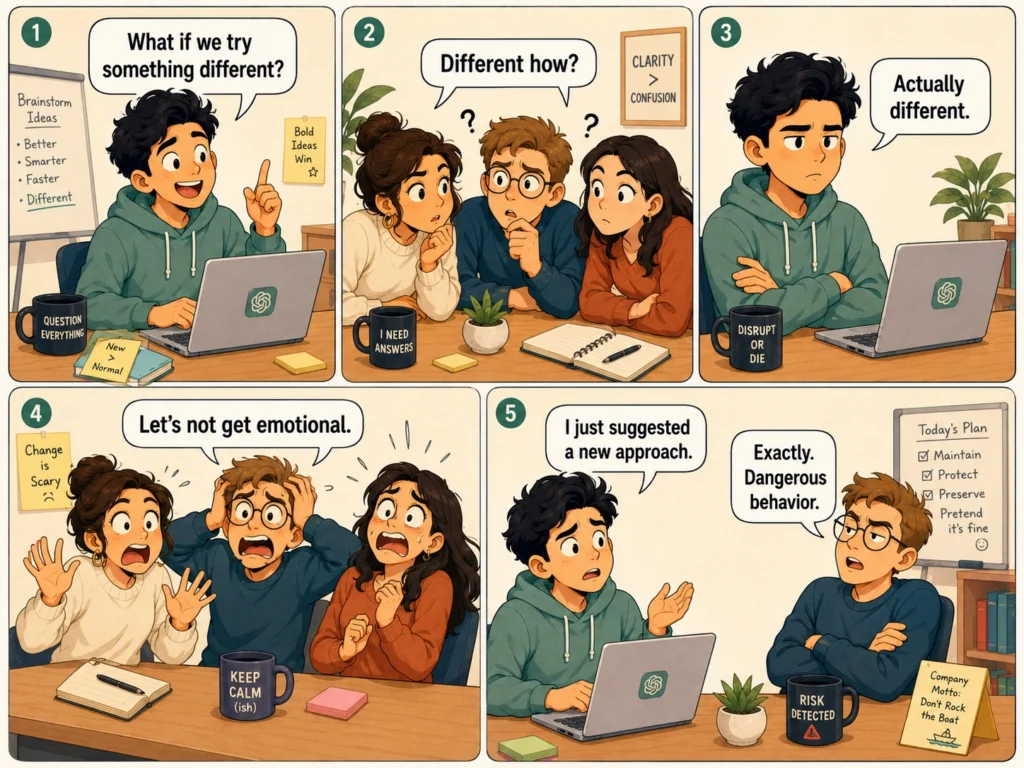
Original ideas expose people because they force them to reveal what they really value. Do they value fresh thinking, or do they value not being blamed? Do they want impact, or do they want safety? Do they want something memorable, or do they want something that can pass through six inboxes without causing a single eyebrow movement?
Most rooms do not fear bad ideas as much as they fear being associated with ideas that are too early.
Everyone wants boldness after someone else proves it
There is a special category of people who love bold ideas once they are already successful.
Before success, they call it risky. After success, they call it visionary. Before success, they ask whether the audience will understand. After success, they say the audience was clearly ready. Before success, they ask for benchmarks. After success, they call it a benchmark.
This is why originality often has to survive loneliness before it earns applause.
The first person to say something different usually sounds unreasonable. The tenth person to repeat it sounds like a trend expert.
You can see this in almost every field. A creator tries a strange format and people ignore it until it works. Then suddenly everyone is “inspired by the format.” A brand takes a different tone and people call it risky until engagement proves it worked. Then everyone starts preparing decks on “the rise of authentic communication.” A person says something honestly and gets called difficult. Later, when the same point becomes popular, people call it “refreshing.”
The idea did not change.
The room became less scared.
The best ideas rarely arrive fully dressed
People expect good ideas to look polished from the beginning. They want the first version to be clear, safe, structured, and confidently presented. But original ideas often arrive messy. They come as a strange sentence, an odd comparison, a half-formed visual, a question that makes the room pause, or a joke that reveals more truth than the official discussion.
That early messiness makes people nervous. So they judge too soon.
But originality needs a little patience. You have to sit with it before deciding whether it is foolish or early. Many good ideas look slightly wrong at first because the room has not caught up with them yet.
That does not mean every strange idea is brilliant. Some strange ideas are just strange. Some deserve to be escorted out quietly.
But if every idea must look safe from the first moment, then you are not asking for originality. You are asking for predictability with better lighting.
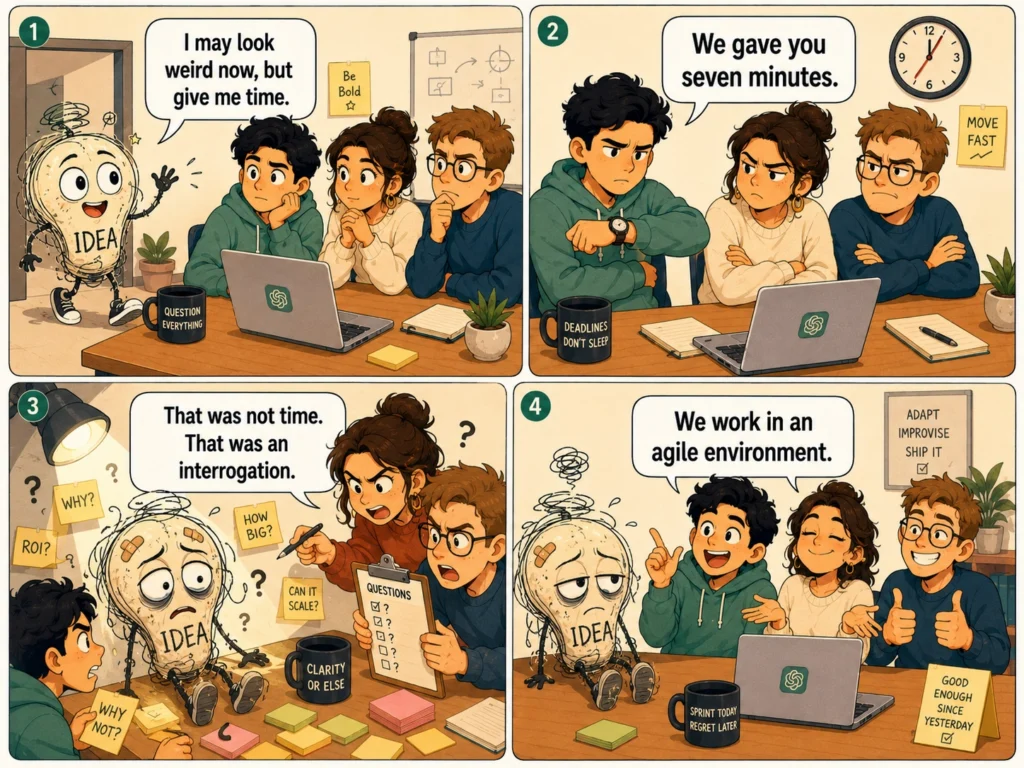
A good idea may need shaping. It may need sharper language, better timing, a clearer story, or a more thoughtful execution. But shaping an idea is different from sedating it.
One makes it stronger.
The other makes it harmless.
Safe thinking is expensive too
People often avoid original ideas because they fear failure. Fair enough. Not every risk is worth taking. Not every bold idea deserves a budget. Not every uncomfortable thought is a breakthrough.
But safe thinking has a cost too. It just hides better.
Safe work does not always fail loudly. It fades quietly. It gets approved. It gets published. It gets polite reactions. It enters the world, does nothing, offends no one, moves no one, and then disappears into the great archive of things that technically happened.
Nobody complains because nobody expected much from it anyway.
That is the comfort of safe work. It protects people from visible failure while quietly guaranteeing irrelevance.
This is why so much content, so many campaigns, so many presentations, and so many “new initiatives” feel strangely forgettable. They are not terrible. Terrible would at least be memorable. They are simply acceptable. They do enough to exist, but not enough to matter.
And that is a very expensive form of safety.
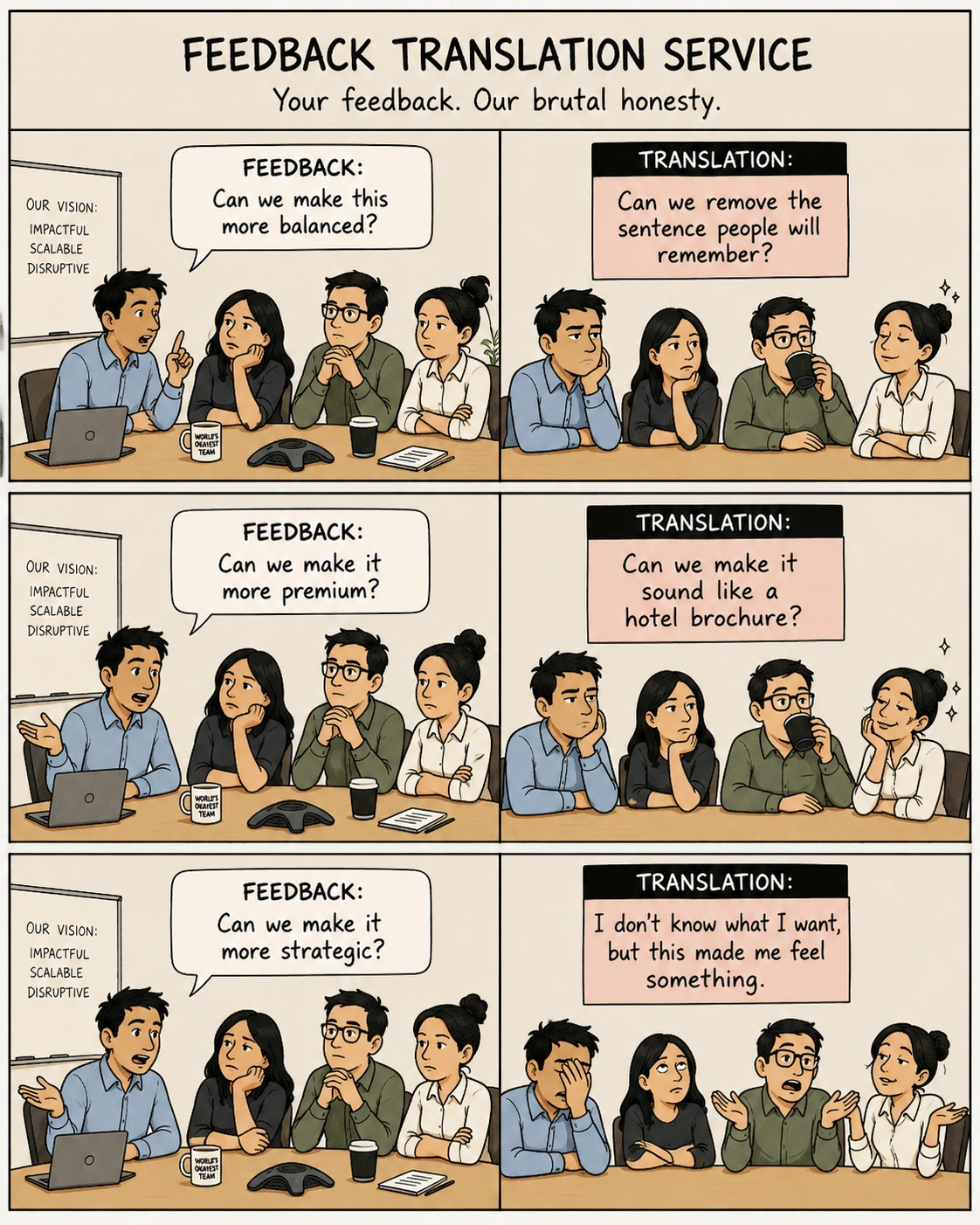
The problem is not feedback. The problem is fear pretending to be strategy.
Good feedback improves an idea. Fear disguising itself as feedback weakens it.
There is a difference between asking, “How do we make this sharper?” and asking, “How do we make this safer?” There is a difference between improving clarity and removing personality. There is a difference between making something work for the audience and making it harmless for the approval chain.
Most ideas do not need blind support. They need intelligent protection.
They need someone in the room who can say, “This part is uncomfortable, but that may be why it is working.” Someone who can separate real risk from personal nervousness. Someone who understands that originality should be shaped, not sedated.
That kind of person is rare.
Because it is much easier to say, “Let’s make it more balanced,” than to admit, “This made me uncomfortable and I am not sure why.”
Original does not mean loud
There is another misunderstanding. People think originality has to be dramatic. It does not.
Originality is not always a wild campaign, a shocking headline, or a visual that looks like it escaped from an art school argument. Sometimes originality is simply saying the obvious thing that everyone else is avoiding. Sometimes it is refusing to use the same dead phrases. Sometimes it is asking a better question. Sometimes it is choosing honesty when the room is reaching for jargon.
Originality is not noise. It is presence.
It is the feeling that a real person made a real choice instead of assembling familiar parts from a drawer labelled “safe ideas.”
That is what people respond to. Not because it is loud, but because it feels alive.
So, do we really want originality?
Maybe the honest answer is: sometimes.
We want originality when it makes us look good. We want originality when someone else has already tested the danger. We want originality after it has been made presentable, measurable, and easy to explain in a review meeting.
But real originality asks for more than applause. It asks for tolerance. It asks for patience. It asks for the ability to sit with discomfort without immediately filing it under “not aligned.” It asks people to stop confusing familiarity with quality.
And that is difficult.
Because the moment an idea feels truly original, it also feels slightly unsafe.
That is not always a problem. Sometimes that is the signal.
So the next time someone says, “We want something original,” maybe the better question is not, “How bold can we go?”
Maybe the better question is:
How uncomfortable are we willing to be before we start making it ordinary?