
There is a new kind of confidence entering meeting rooms.
It does not come from research, customer conversations, failed experiments, or the slow pain of actually understanding something.
It comes from a prompt.
One good prompt, one polished answer, one neat framework, and suddenly the room has a new strategist. Someone who discovered the future of an entire business function sometime between opening ChatGPT/Claude and finishing their coffee.
To be fair, AI is impressive. It can take a messy thought and make it presentable in seconds. It can organize chaos, create a framework, sharpen language, and make a half-formed idea look like it spent a weekend at a leadership retreat.
And honestly, sometimes the output is good. And that is exactly what makes it dangerous.
Because when AI gives people obviously bad output, they reject it. But when it gives them something clean, confident, and well-structured, they often mistake it for finished thinking.
That is where AI-powered overconfidence begins.
The problem is not AI. The problem is the shortcut pretending to be expertise.
People are now generating positioning documents, campaign ideas, blogs, whitepapers, and sometimes even strategies in minutes. That alone is not the issue. Speed is useful. AI can absolutely help us work faster and think wider.
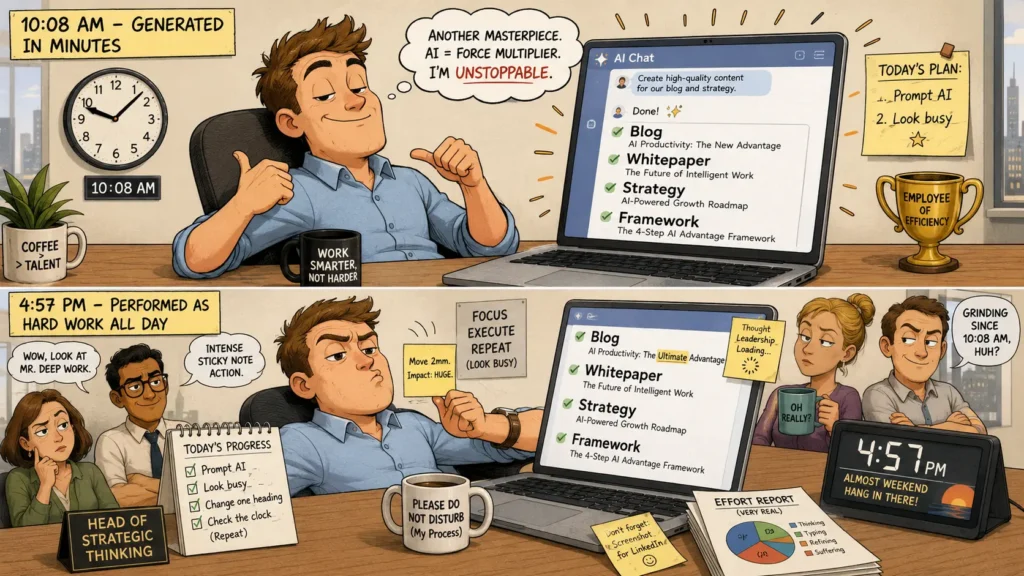
The issue begins when someone generates something in minutes, barely reads it, presents it as their own thinking, and then behaves like they spent the whole day building it.
That is not productivity. That is theatre.
There is a new workplace performance where the output is ready by 10:15, but the person remains mysteriously “working on it” till evening. Not because they are refining the thinking. Not because they are validating the logic. Not because they are testing the idea against reality.
Mostly because admitting it took eight minutes would make the whole thing look too cheap.
So the workday becomes packaging. A few words changed here. A heading adjusted there. Maybe a line added to make it feel “custom.” Then comes the serious face in the meeting, the careful tone, and the casual suggestion that this took deep effort.
Please….!
If the thinking is solid, nobody cares whether AI helped you get there faster. But if the only real work was waiting long enough to make the output look earned, then the problem is not AI. The problem is pretending.
Polished output can hide lazy thinking
Before AI, weak thinking usually looked weak. A first draft had rough edges. A shallow idea had visible gaps. You could tell when someone had not gone deep enough because the work itself gave them away.
Now, AI covers the tracks.
It gives structure before the thought has earned structure. It gives language before the person has fully understood the logic. It gives confidence before the idea has been tested.
This is why people get dangerous after three prompts. They are not always more informed. They are just better formatted.
They walk into discussions with AI-generated confidence and human-level assumptions. They say things like “the strategy is clear” when what they really have is a nicely arranged possibility. They use words like “ecosystem,” “framework,” “transformation,” and “customer-centricity” with the confidence of someone who has not yet been asked to explain what any of it means in this specific case.
And when you do ask, the answers become soft.
>> “We can look at it holistically.”
>> “It depends on the larger context.”
>> “This is more of a directional thought.”
>> “We can refine it further.”
Translation: “I have not understood this deeply enough to defend it.”
Three prompts are not a strategy
AI can help create a strategy. But three prompts are not a strategy.
A strategy has to survive reality. It has to survive customers who do not care about your beautiful framework. It has to survive sales teams who need to explain it without sounding like they swallowed a whitepaper. It has to survive delivery teams who will eventually have to do the thing you promised.
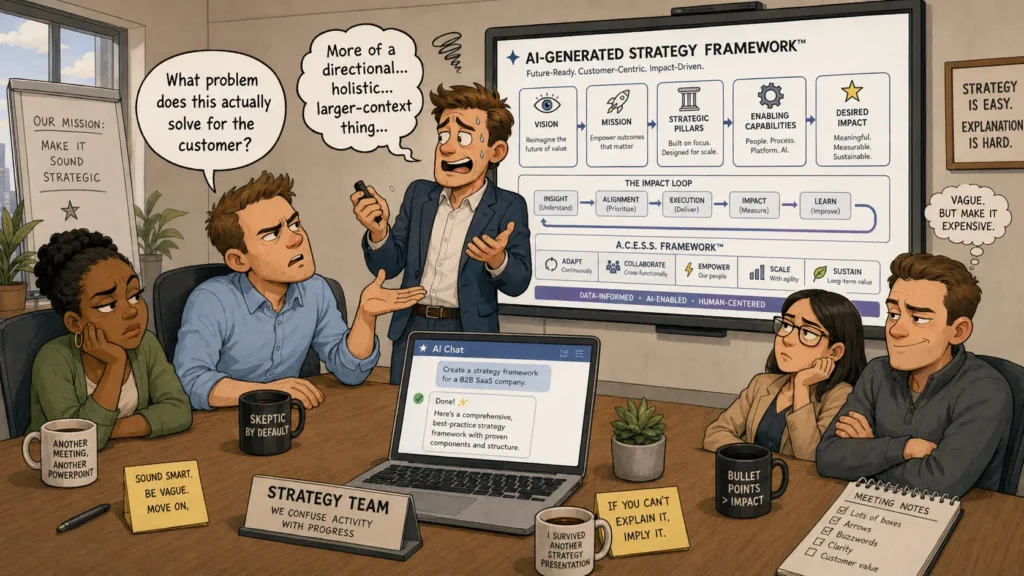
It also has to survive cross-questioning.
That is where AI-assisted work often gets exposed. Not when it is being presented. Presentation is easy. The real test begins when someone asks why the recommendation makes sense, what assumption it depends on, what trade-off it creates, and what happens if it fails.
If the person can answer, great. AI helped them think.
If they fumble, hide behind vague language, or repeat the slide in a different tone, then AI did not help them think. It helped them decorate the absence of thinking.
That difference matters.
The new skill is not prompting. It is ownership.
Everyone is talking about prompting. Prompting matters, yes. A better prompt gives a better answer. But prompting is not the final skill.
Ownership is.
If you are recommending a strategy, presenting a whitepaper, putting your name on a blog, or using AI-generated thinking to influence a decision, then you need to understand what you are carrying into the room.
You need to know where it is strong. Where it is weak. What assumption it is built on. What part is generic. What part needs proof. What part sounds good but says nothing. What part will collapse the moment someone asks a real question.
That is the actual work.
The useful person is not the one who can generate ten polished options in ten minutes. Everyone will be able to do that. The useful person is the one who can look at those ten options and say, “This one is weak,” “This will not work for our audience,” “This claim needs evidence,” or “This sounds intelligent, but it is not true enough yet.”
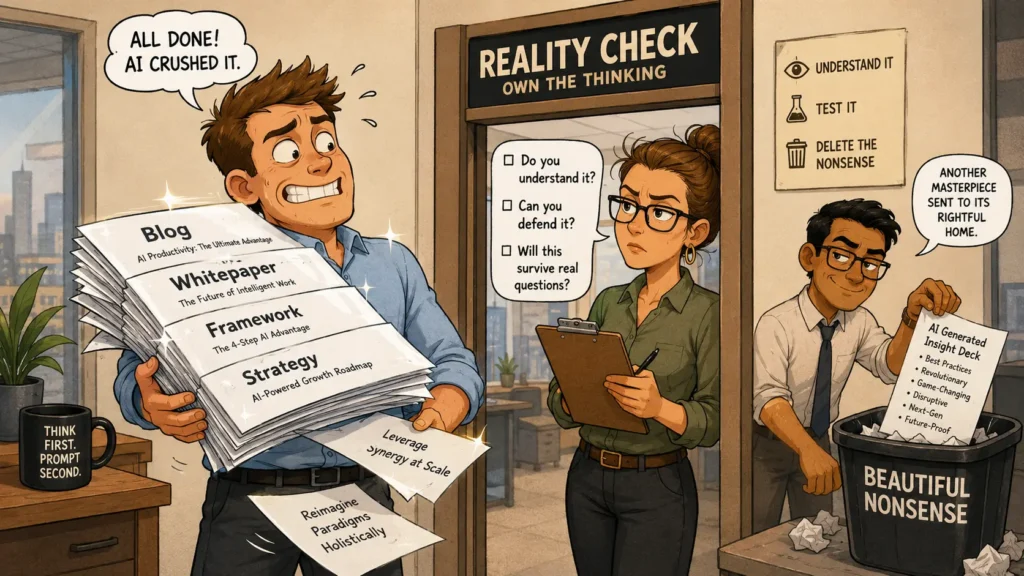
Sometimes the real work is not generating more.
Sometimes the real work is deleting the beautiful AI-generated paragraph because you finally realized it was just confident nonsense.
How to Use AI Without Borrowing Its Confidence
- Understand before you present
Don’t just copy the output into a slide or document. Know what it is saying, why it makes sense, and where it may fall apart. - Test it against reality
Ask whether a customer, sales team, manager, or subject expert would actually understand and accept it. If it cannot survive one honest question, it is not ready. - Remove the beautiful nonsense
AI loves polished sentences that sound intelligent but say nothing. Delete anything that does not add clarity, proof, direction, or meaning. - Own the thinking, not just the output
Once your name is on it, it is your responsibility. AI may generate it, but you still need to defend it. - Use AI to move faster, not to pretend harder
Speed is useful. Pretending something took all day when you barely understood it in ten minutes is not productivity. It is performance.